

FOR IMMEDIATE RELEASE
Date: 21 May 2026
FOUR YEARS. THREE PROTESTS. ONE COURT ORDER. ONE MEDIATION. ZERO CHANGE.
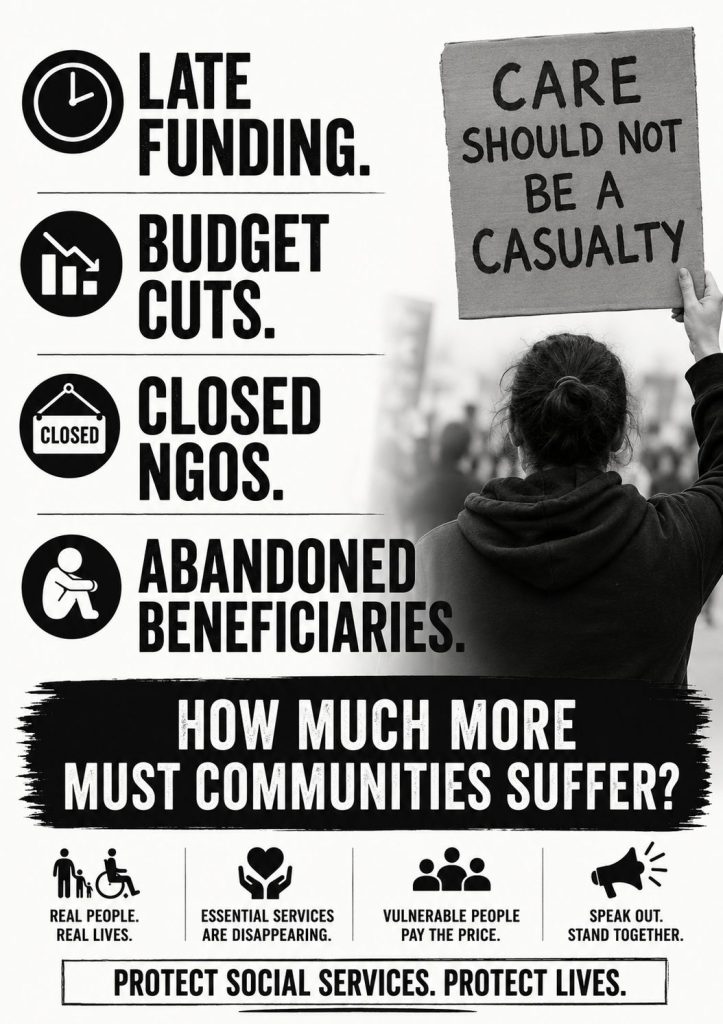
Gauteng’s social care sector takes to the streets again as the Gauteng Department of Social Development (GDSD) neglects its own funding policy for the fourth consecutive year – and vulnerable communities pay the price.
Hundreds of non-profit organisations will picket outside the Gauteng Department of Social Development’s head office in Johannesburg on Friday 22 May at 10am, demanding payment of outstanding subsidies and accountability for chronic delays that have left organisations without funding for nearly two months.
The picket, organised by the Gauteng Care Crisis Committee (GCCC), will be accompanied by a memorandum of demands. It is the sector’s fourth action against the GDSD in as many years. Each time, the department has been in breach of obligations it has been legally bound to meet since a landmark court ruling in 2010.
The 2010 NAWONGO court judgement set out the state’s constitutional obligations to vulnerable people and the principles informing how government must fund the organisations that serve them. These are contained in the national DSD’s Sector Funding Policy which states that contracts must be signed with NGOs by 25 March and payments must follow in April.
In 2026, as in 2023, 2024, and 2025, the GDSD has failed to meet this standard. Organisations that ensure older persons receive meals, care and company, who shelter women fleeing violence, care for children with disabilities, and support families in crisis are left to absorb the consequences.
In 2023 organisations protested outside the GDSD offices. In 2024, organisations both protested and went to court, obtaining an urgent supervisory order compelling the department to make decisions and pay organisations. In 2025, organisations who were still unpaid from 2024 opted for mediation, granting the GDSD the benefit of the doubt. The department was still late, with only a few organisations paid on time. This time the Children’s Sector of the Civil Society Forum protested.
In 2026, the delays continue. Contracts have been issued with errors, offices are still awaiting decisions and payments remain outstanding. Once again, services are disrupted and livelihoods at risk – for the fourth consecutive year.
“We are tired of being the Gauteng Care Crisis Committee. We don’t want to be in crisis anymore. This should be about care – not crisis.”
Lisa Vetten, GCCC Chairperson
WHAT THIS COSTS
The 2024 statements of impact, collected from 18 GCCC member organisations facing closure at the start of the financial year, offer a snapshot of what late payments do in practice.
Epworth Children’s Home – more than a century old – closed their doors, causing 50 children to lose their placements. They later reopened due to public outrage and support. People Opposing Women Abuse (POWA) faced the closure of six offices, two shelters, and five victim-friendly rooms serving almost 13,000 beneficiaries annually, including survivors of gender-based violence. Khulisa Social Solutions closed 10 main offices and four satellite offices across the province, directly affecting nearly 20,000 community members. At domestic violence shelters, women fleeing abuse were told there was no certainty about whether services would continue.
One woman, sheltering with four children from a husband who had tried to kill them, asked: where are we supposed to go?
“When administrative systems fail, the impact is felt directly by organisations and the communities they serve. In this way the GDSD undermines its own purpose.”
Lisa Vetten, GCCC Chairperson
This is not only a policy failure. The 2010 NAWONGO judgement was clear: NGOs providing care to children, older persons, and vulnerable people fulfil constitutional and statutory obligations of the department. When the GDSD delays funding to NGOs, it is not an administrative inconvenience, it is the state failing to fulfil its constitutional obligations to the people of Gauteng.
THE GCCC’S DEMANDS
The Gauteng Care Crisis Committee calls on the GDSD to:
- Pay all outstanding subsidies to funded organisations by the end of May.
- Publish a comprehensive, public status update on the 2026/27 funding process – including the number of business plans received and approved, contracts issued, and funding awarded.
- Provide a list of all organisations as at 22 May still awaiting decisions on their business plans, as well as a list of payments. Explain both sets of delays. Organisations are owed reasons, not silence.
- Provide dates of payment for the remaining three quarters of 2026/27 and commit to these.
- Commit to reforming the contracting process so that contracts are fair; processes and their timelines are detailed in advance; and services are properly costed to ensure that NGOs receive subsidy amounts that realistically reflect the cost of their services. We don’t want to be back in 2027.
Sign SLAs now. Pay NGOs. Today.
FOR MEDIA ENQUIRIES AND INTERVIEWS
Beena Chiba, Gauteng Provincial Association for Persons with Disabilities: 083 577 1037
Sam Mokgopha, Kids Haven: 073 265 4135
Sima Diar, Nisaa Institute for Women’s Development: 081 041 5072
Lisa Vetten, GCCC Chairperson: 082 822 6725
ABOUT THE GCCC
The Gauteng Care Crisis Committee is a coalition of over 150 non-profit organisations and their branches formed in response to the ongoing crisis caused by the GDSD’s chronic delays in funding social care NGOs. Its member organisations deliver services to children, older persons, people with disabilities, survivors of gender-based violence, and other vulnerable communities across the province.

